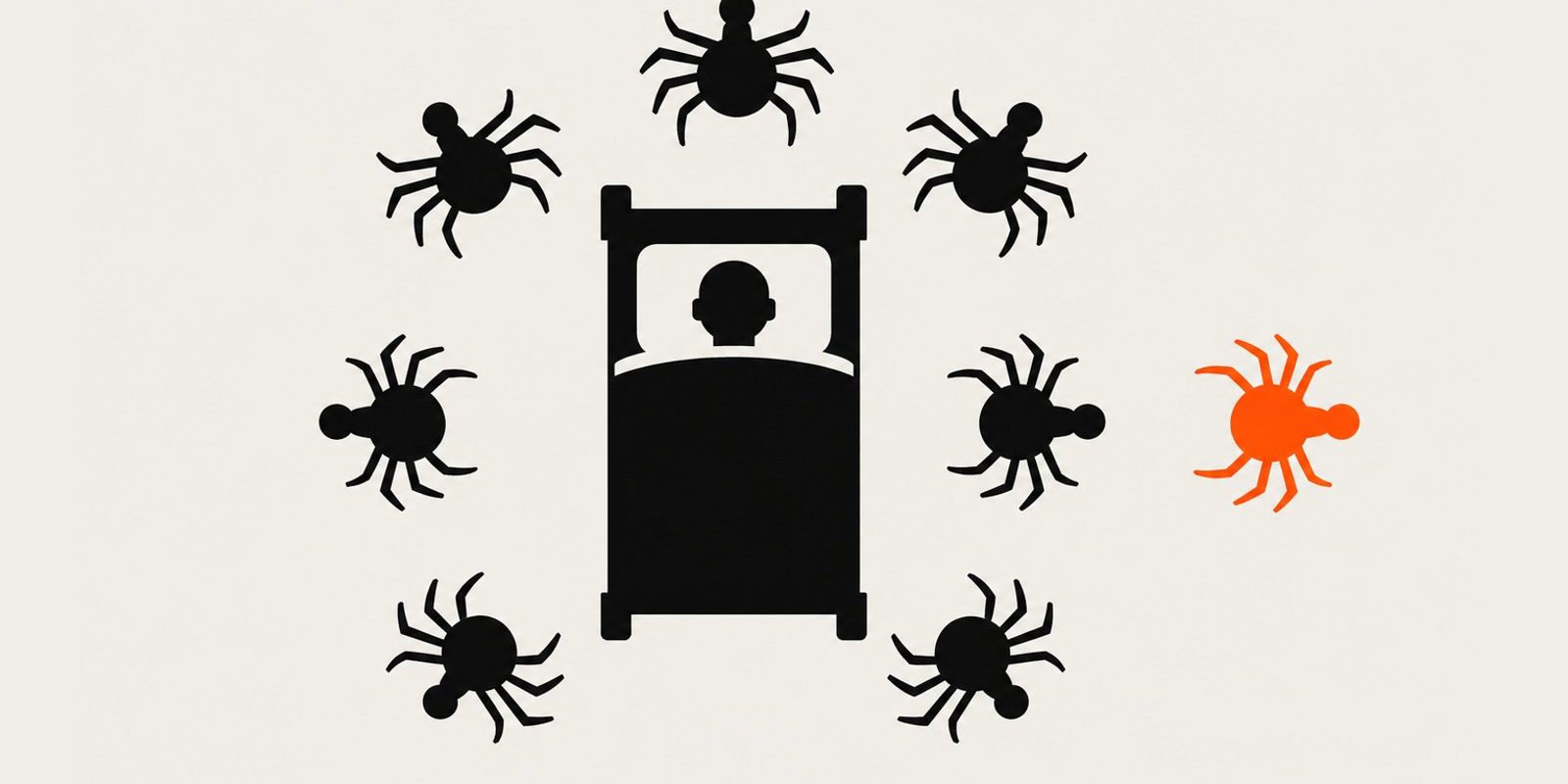
You are dozing off in a quiet bedroom when a friend offers a bonus fact you did not ask for: the average person swallows eight spiders a year in their sleep. Now you are wide awake, staring at the ceiling.
It is a perfect party fact: gross, specific and easy to repeat. But if you try to find where it came from, the trail ends in a story that may be just as made up as the spiders. Let’s look at what can actually be verified.
The verdict
Verdict: myth. No one has documented a spider crawling into a sleeping person’s mouth, and the experts who study spiders say it makes little sense that they would. The famous origin story is also shaky, so the cleanest summary is that nobody has found any real evidence behind the number.
The origin story, and why to doubt it
For years, the standard explanation went like this. In 1993, a columnist named Lisa Holst wrote in a magazine called PC Professional about how easily people believe nonsense. To prove it, she supposedly invented a list of ridiculous “facts,” including the eight-spiders claim, and the list went viral by email. That account was popularized by Snopes (as quoted by Mental Floss).
The trouble is that the story cannot be checked. A web search turns up almost nothing on Holst or the magazine. One blogger who looked for the source failed to find it, and the Library of Congress told him it had no record of the magazine (Mental Floss). Mental Floss summed it up: “The columnist, the column and the magazine don’t seem to exist, or were at least lost to history.”
Some retellings go further and note that “Lisa Birgit Holst” is an anagram of “This is a big troll.” I found that only in secondary summaries and could not open the Snopes page to check it, so treat it as reported, not confirmed. The same goes for the claim that she borrowed the statistic from a 1954 book on insect folklore. I could not confirm the title or the page.
What the spider experts say
The curator is Rod Crawford of the Burke Museum in Seattle, who told Mental Floss he has “never seen or heard a single good eyewitness account” of a spider entering a sleeping person’s mouth.
The behavior argument is just as strong. Crawford told Scientific American that vibrations are a “big slice of spiders’ sensory universe,” and that “a sleeping person is not something a spider would willingly approach” (Scientific American, 2014). A sleeping body breathes, snores and has a beating heart. To a spider, that is a lot of tremor.
Spiders regard us much like they’d regard a big rock.
Bill Shear, biology professor and former president of the American Arachnological Society (Scientific American, 2014)
Shear added that we are so large that we are really just part of the landscape to a spider (Scientific American, 2014). In other words, a spider is far more likely to walk around you than into you.
| Part of the story | What can be checked |
|---|---|
| Eight spiders a year | No study or measurement found |
| 1993 Lisa Holst column | Column, writer and magazine could not be found |
| Spiders approach sleepers | Experts say unlikely: vibrations, size, no prey value |
| Documented cases | Curator Crawford knows of no good eyewitness account |
The part that complicates the debunk
Here is the awkward bit. The “it started as a hoax” story is itself a story. It may be right. It may also be a tidy explanation that people repeated without anyone seeing the column. Several sources say the magazine cannot be found, and that is as far as the evidence goes. The honest position is that the claim’s origin is unknown, and the Holst account is unproven.
It also helps to be precise about what the experts are saying. They are not claiming that a spider has never, in the history of humanity, crawled onto a person who was asleep. They are saying that the idea that it happens eight times a year to everyone has no support, and that spiders have every reason to avoid it. Absence of reports is not a mathematical proof, but it is a strong hint when the claim is that this is happening to most of the planet every year.
Why it spreads
A number makes a claim feel researched. “Some spiders” is a vague fear. “Eight a year” sounds like someone counted. That is a pattern worth noticing: a specific figure with no named source is a reason to ask where it came from.
The takeaway
The spider part is probably false. The part about the origin story needs the same suspicion.