You are at a dinner table and someone asks how long money takes to double at 6% a year. A friend glances at the ceiling for two seconds and says, “Twelve years.” No calculator, no spreadsheet. She is right to within a few weeks.
The trick is a mental shortcut called the Rule of 72. Divide 72 by the yearly growth rate, and you get the number of years it takes to double. It is more than 500 years old, and it works in both directions: on savings, on prices and on debt.
An old rule with no known inventor
The earliest known printed mention is in Luca Pacioli’s 1494 math textbook Summa de arithmetica, printed in Venice (Wikipedia, citing the Summa, folio 181). Pacioli gives the rule without explaining where it comes from. That has led historians to suspect that merchants were using it before he wrote it down. The story that Albert Einstein invented it has no evidence behind it.
Why 72? The exact doubling time at a rate r is the natural log of 2 divided by the natural log of (1 + r). For ordinary rates that works out close to 69.3 ÷ r, and 72 is a friendly nearby number. It divides evenly by 2, 3, 4, 6, 8, 9 and 12, which makes mental math easy.
How close is it?
We checked the shortcut against the exact formula. These are illustrative growth rates, not forecasts of any real investment.
| Yearly rate | Rule of 72 | Exact doubling time | Off by |
|---|---|---|---|
| 2% | 36.0 years | 35.0 years | +2.8% |
| 4% | 18.0 years | 17.7 years | +1.9% |
| 6% | 12.0 years | 11.9 years | +0.9% |
| 8% | 9.0 years | 9.0 years | -0.1% |
| 10% | 7.2 years | 7.3 years | -1.0% |
| 12% | 6.0 years | 6.1 years | -1.9% |
Between 2% and 12% the shortcut is never off by more than 3%. It is most accurate near 8%, and that is probably why 72 won out over other numbers.
Running it backward: inflation
Here is where the rule gets uncomfortable. If prices double, money loses half its buying power. The Federal Reserve’s longer-run goal is 2% inflation a year, measured by the PCE price index (Federal Reserve, reaffirmed January 2026). At a steady 2%, prices double in about 35 years, so a dollar would buy about half as much.
| Steady inflation | Prices double in | $100 buys what $50 buys today after |
|---|---|---|
| 2% | about 35 years | about 35 years |
| 3% | about 23 years | about 23 years |
| 5% | about 14 years | about 14 years |
Inflation is never perfectly steady, so treat these as what-if numbers. The point is the scale. A small percentage that sounds harmless, repeated for a generation, quietly halves the value of cash.
Small rates look small. The calendar is what makes them big.
digitgazette.com (our own line, not a quotation)
Running it backward: debt
The same math runs against borrowers. In August 2026, the average interest rate on credit card accounts that were charged interest was 22.36% a year (Federal Reserve G.19, 2026). If a balance were left untouched at that rate, with no payments and no new purchases, the Rule of 72 says it doubles in about 3.2 years.
Where the shortcut breaks
That credit card number is also a warning about the rule itself. At 22.36%, the exact doubling time is 3.4 years, and the shortcut says 3.2. It is off by about 6%. The higher the rate, the more the rule drifts.
Other limits are worth knowing. The rule assumes the growth rate stays the same every year, and real investment returns do not. It ignores fees, taxes and the timing of deposits. And it describes a single lump sum, not money added every month. It is a way to feel the shape of compounding, not a way to predict a result.
What sticks
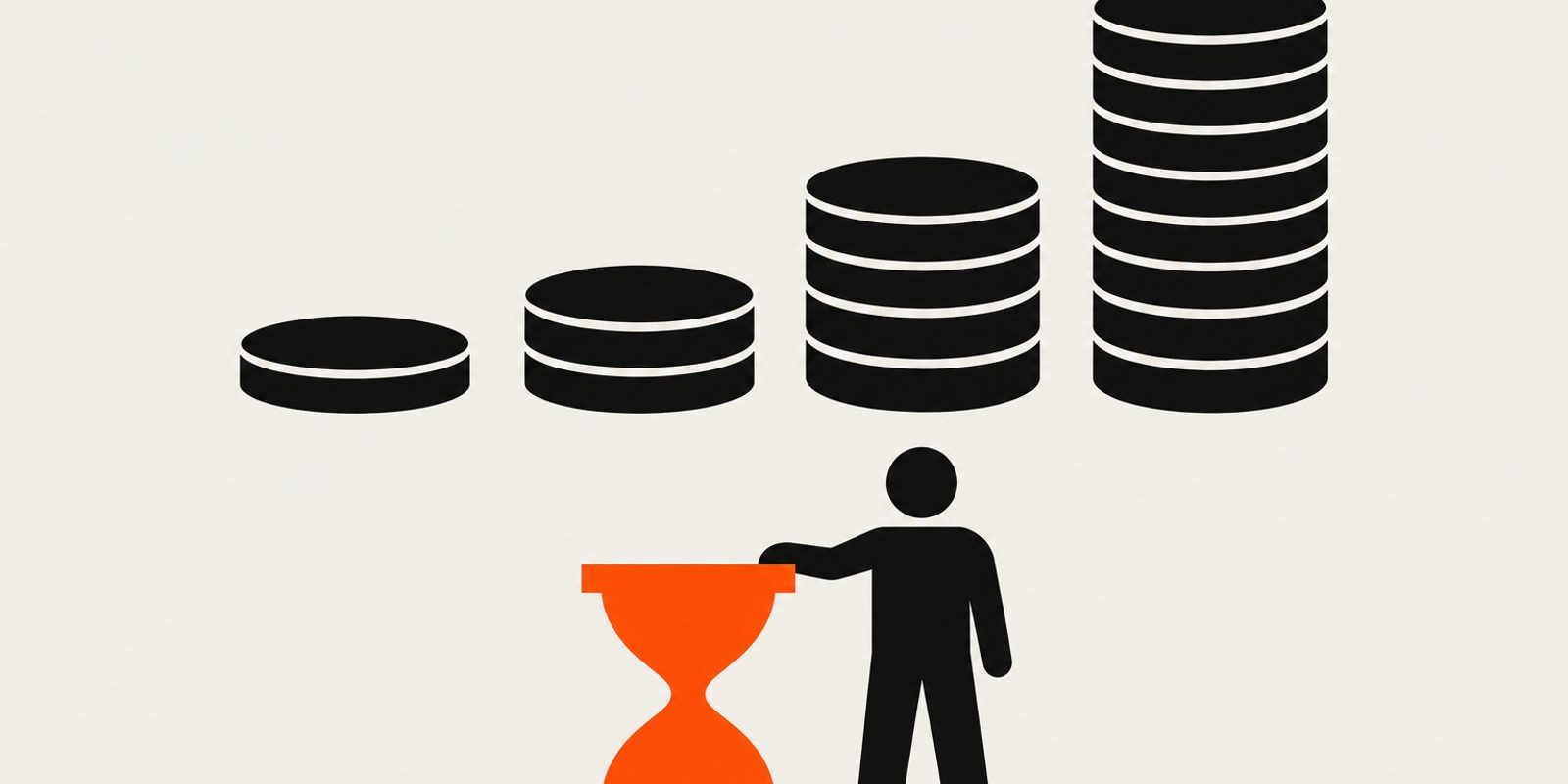
The rule also shows why the calendar matters as much as the rate. At an illustrative 6%, $1,000 becomes about $2,000 in 12 years, $4,000 in 24 and $8,000 in 36. Each doubling takes the same time but adds more dollars than the one before.
Divide 72 by any rate and you know how long a number takes to double.
For illustration only. Not financial advice.
Sources
- “Rule of 72”, Wikipedia (citing L. Pacioli, Summa de arithmetica, Venice, 1494, folio 181). link
- Board of Governors of the Federal Reserve System, “Statement on Longer-Run Goals and Monetary Policy Strategy”, reaffirmed January 27, 2026. link
- Board of Governors of the Federal Reserve System, “Consumer Credit – G.19”, release of November 6, 2026 (credit card plans, accounts assessed interest, August 2026). link
- Doubling times computed by digitgazette.com with the formula ln(2) / ln(1 + r); all rates other than the Fed figures are illustrative assumptions.