Imagine a letter arrives with a bold line: “Your result was positive.” The test behind it is, say, 99% accurate. Your stomach drops. Surely that means you almost certainly have the condition.
It does not. Not even close, if the condition is rare. This is the false positive paradox, and it trips up students, journalists and, in studies, even doctors. Here is why, using a made-up test so no real person is involved.
A hypothetical test, 10,000 people
Let us invent a condition that affects 1 person in 1,000. Let us also invent a test for it that is right 99% of the time in both directions: it flags 99% of people who have the condition, and it correctly clears 99% of people who do not. This is a teaching example, not any real test, and not medical advice.
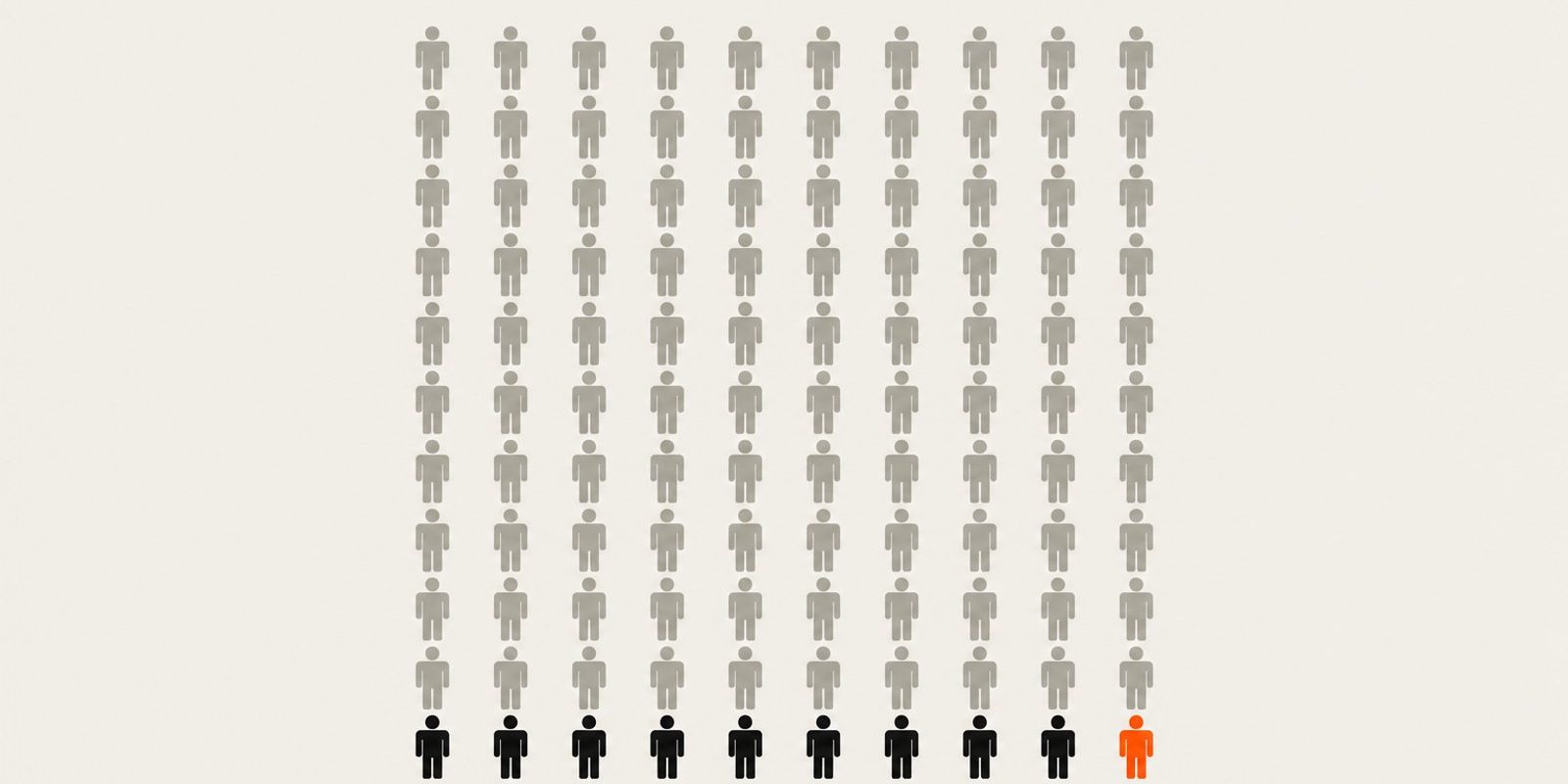
Now test 10,000 random people.
- People who have the condition: 10 (1 in 1,000 of 10,000).
- Of those 10, the test flags about 9.9. Call it 10.
- People who do not have it: 9,990.
- Of those, 1% get flagged by mistake: about 99.9. Call it 100.
So roughly 110 people get a positive result. Only about 10 of them truly have the condition. The rest, about 100, are false alarms. Exactly: 9.9 divided by (9.9 plus 99.9) is 9.0%.
Why a great test can still be mostly wrong
The trap is hidden in the word “accurate.” A 99% accurate test makes mistakes on 1% of healthy people. When there are thousands of healthy people and only a handful of sick ones, that small 1% is applied to a huge crowd. The false alarms pile up and swamp the true hits.
Statisticians call the starting share, here 1 in 1,000, the base rate. Ignoring it is called base-rate neglect. The test’s accuracy tells you how it behaves on a person whose status you know. A positive result asks the reverse question: given the result, what is the person’s status? Those are different questions with different answers.
Change the base rate, change everything
Keep the same 99% test and only change how common the condition is. Our own calculation, for 10,000 people:
| How common | True positives | False positives | Positive result is real |
|---|---|---|---|
| 1 in 1,000 | 9.9 | 99.9 | 9% |
| 1 in 100 | 99 | 99 | 50% |
| 1 in 10 | 990 | 90 | 92% |
| 1 in 2 | 4,950 | 50 | 99% |
The same test goes from nearly useless to nearly perfect. Nothing about the test changed. Only the crowd did.
What happened when doctors were asked
In 1982, researcher David Eddy gave physicians a screening problem with a 1% base rate, about 80% sensitivity and a 9.6% false-positive rate. The correct chance of disease after a positive result is about 7.7%. Most of the doctors he asked guessed between 70% and 80%, apparently mixing up the test’s sensitivity with the chance a positive result is real (Eddy, 1982, as summarized by Gigerenzer in the Association for Psychological Science Observer).
The German psychologist Gerd Gigerenzer found the same pattern decades later. In a screening problem where the true answer is about 10%, doctors’ guesses ranged from 1% to 90%, and the most common answer was 90%. In 2007 he tested 160 gynecologists and found the same result (Gigerenzer, Observer; Gigerenzer et al., Psychological Science in the Public Interest, 2007).
Chance of being real: not how good the test is, but how rare the thing is.
Our own line, not a quotation
The fix is just counting people
Gigerenzer’s lesson is not that doctors are bad at math. It is that percentages and conditional probabilities are a confusing way to present risk. Counts of real people are easier. In one of his training sessions, a group of 150 gynecologists who attended a one-hour lecture went from 21% to 87% understanding of the chance of cancer after a positive test (Gigerenzer, Observer).
That is exactly what we did above: “10 out of 110” is clearer than any formula.
The twist: a positive result is not worthless
Do not walk away thinking tests are pointless. Before the positive result, our hypothetical person had a 0.1% chance of having the condition. After it, they have about 9%. That is a ninety-fold jump. A positive result is a reason to look closer, not a verdict. In real life, a first screening test is often followed by a more precise second test, which shrinks the uncertainty fast. How to read any real result belongs in a conversation with a qualified clinician.
Accuracy is only half the story. The other half is how rare the thing is.
Sources
- Gerd Gigerenzer, “Helping Physicians Understand Screening Tests Will Improve Health Care”, Association for Psychological Science Observer (Eddy’s 1% / 80% / 9.6% problem and 7.7% answer; 160 gynecologists, 2007; 150 gynecologists 21% to 87%). link
- Gigerenzer, G., Gaissmaier, W., Kurz-Milcke, E., Schwartz, L. M. and Woloshin, S., “Helping Doctors and Patients Make Sense of Health Statistics”, Psychological Science in the Public Interest 8(2), 2007. link
- Eddy, D. M., “Probabilistic reasoning in clinical medicine: problems and opportunities”, in Judgment Under Uncertainty, Cambridge University Press, 1982. link
- Own calculation for the hypothetical 99% test (Bayes’ rule with counts), 2026.