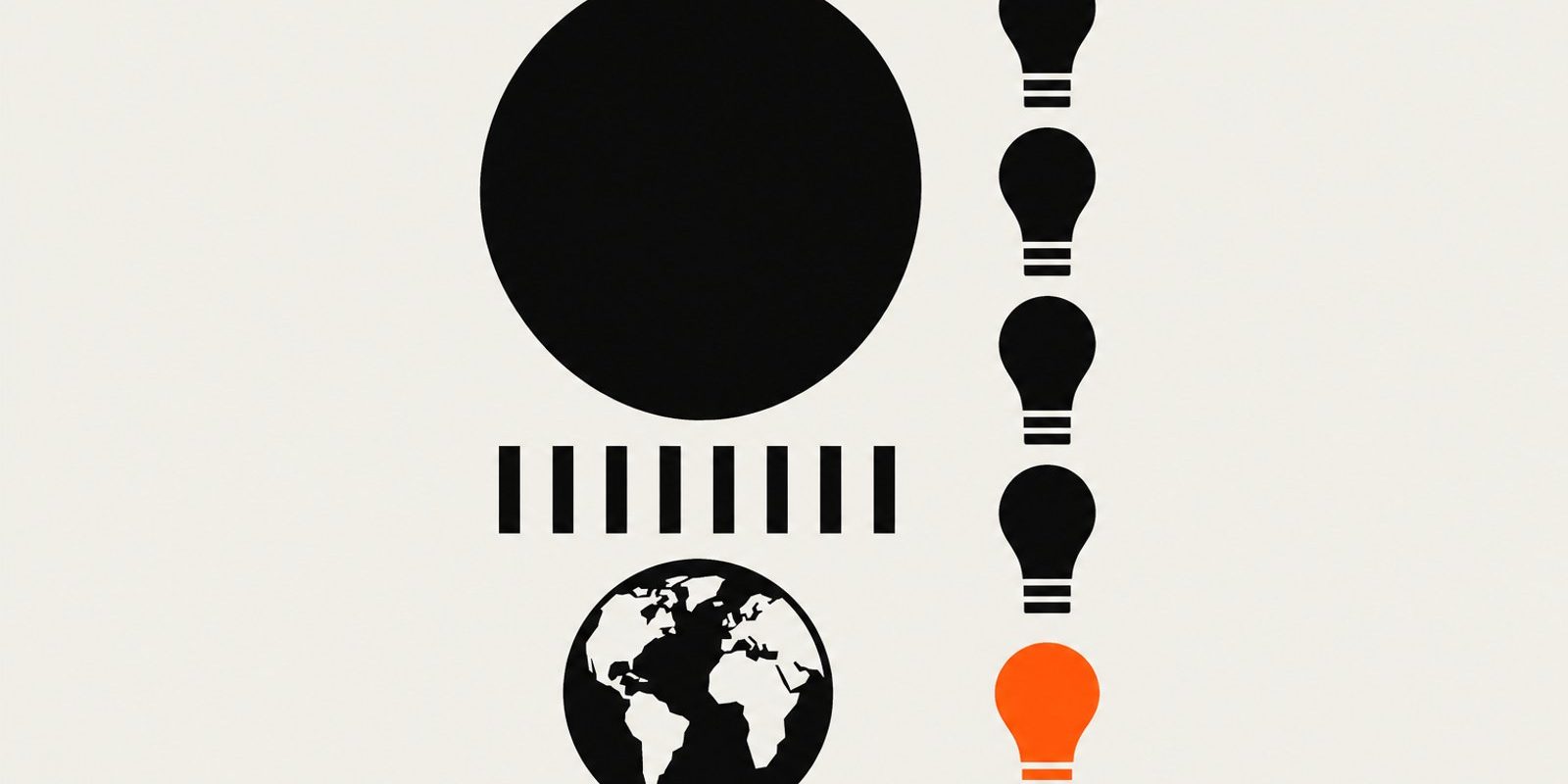
You have probably heard the line: in one hour, the sun sends Earth more energy than all of humanity uses in a whole year. It sounds like a poster slogan. Is it true?
Mostly, yes, but only if you read it the right way. The answer depends on where you measure the sunlight, and the “hour” stretches to about two once you count only what reaches the ground.
How much sunlight hits Earth
NASA’s satellite measurements put the sunlight arriving at Earth’s distance at about 1,361 watts per square meter, measured facing the sun above the atmosphere (NASA, SORCE and TSIS-1 missions). Earth intercepts that light with its round shadow, a disc with the planet’s radius of 6,371 kilometers (NASA Earth Fact Sheet). That disc has an area of about 1.275 times 10 to the 14th square meters.
Multiply the two and Earth intercepts about 174,000 trillion watts, or 174,000 terawatts. In one hour, that is about 625 exajoules of energy. An exajoule is a billion billion joules, a unit used for national and world energy budgets.
How much energy humanity uses
The Energy Institute’s Statistical Review of World Energy reported that global energy supply passed 600 exajoules for the first time in 2025, up about 1.7% from 2024 (Energy Institute, 2026). That is the total for oil, gas, coal, nuclear, hydro and renewables, a measure of all the energy our economy draws on. In 2024 it was a bit under 600, around 590, by our back-calculation.
So the quick comparison works. About 625 exajoules of sunlight arrive in an hour. The world used a little over 600 in a whole year. At the top of the atmosphere, the claim is almost exactly right: roughly 58 minutes.
Where the “one hour” gets stretched
Here is the catch. That 625 exajoules is the sunlight arriving at the top of the atmosphere. Not all of it stays. NASA’s energy-budget figures say about 29% bounces straight back to space off clouds, ice and bright surfaces. About 23% is absorbed by the atmosphere. The remaining 48% is absorbed by the surface (NASA Earth Observatory).
The table shows how the hour grows depending on what you count, using the 2025 world supply of 600 exajoules.
| What you count | Share of sunlight | Energy per hour (EJ) | Time to match one year of world supply |
|---|---|---|---|
| All sunlight reaching Earth | 100% | about 625 | about 58 minutes |
| Sunlight absorbed (air and ground) | 71% | about 444 | about 1 hour 21 minutes |
| Sunlight absorbed by the surface | 48% | about 300 | about 2 hours |
Our own sums, built from NASA’s figures and the Energy Institute total. The slogan is honest at the top, about right in the middle, and “about two hours” if you only count ground-level sun.
Why this does not mean we can just use it all
This is the part that gets lost on posters. The sunlight is real. The problem is catching it.
The sun delivers the energy. The hard part is the catching.
Our own line, not a quote from a source
Most of the surface is ocean, ice, forest or farmland. Solar panels convert only a fraction of the light that hits them into electricity. Night and cloudy days cut output. Energy also has to be stored or moved, which costs more. And the world’s energy supply figure counts the heat inside the fuels we burn, not just electricity, so the two are not measured the same way.
It is a fair measure of potential. It is not a measure of what we can get. Solar in 2025 supplied 1.7% of world primary energy, about 10 exajoules, even though it was the fastest-growing source (Energy Institute, 2026). That was after solar power generation grew 30% in a single year.
Why the slogan keeps surviving
Another reason this slogan lasts is that it is true in a loose sense. Stretch the unit a little and it still holds. Over a full year, Earth intercepts about 5.5 million exajoules of sunlight, which is roughly 9,000 times the world’s annual energy supply.
That ratio is the real picture. Humanity’s whole energy habit is a small fraction of one day of sun. The gap between “available” and “usable” is where the engineering, and the money, goes.
The sun’s hourly gift matches a year of human energy use, and most of it is not ours to take.
Sources
- Energy Institute, “Statistical Review of World Energy” (2026 edition, covering 2025), as reported by DieselNet, 2026. link
- NASA, “Total Solar Irradiance” (SORCE and TSIS-1 solar irradiance science pages), NASA Goddard. link
- NASA Space Science Data Coordinated Archive, “Earth Fact Sheet”, updated 2024. link
- NASA Earth Observatory, “Climate and Earth’s Energy Budget”. link