Your inbox pings. Then pings again. By the end of a normal workday, you may have handled a hundred messages without thinking about any of them.
Now multiply that by everyone on Earth who has an email address. The total is hard to picture, and, as it turns out, hard to pin down. Nobody counts every email. The big numbers you see online are estimates, and it helps to know whose.
The estimate everyone quotes
The figure most often repeated comes from The Radicati Group, a market-research firm. Its Email Statistics Report 2024-2028, published in late 2024, estimated that people sent and received about 361.6 billion emails per day worldwide in 2024. It projected 376.4 billion per day for 2025 and 392.5 billion for 2026 (The Radicati Group, 2024). We could not open the report itself. These figures come from summaries quoting it, so treat them as second-hand.
Two cautions matter here. First, 2025 and later are forecasts, not measured totals. Second, the figure counts emails “sent and received,” so it is not simply the number of messages written. One email sent to five people can count several times. Radicati’s exact counting method is not public, so the true number of distinct messages is likely lower.
Per second, per person
Divide 376.4 billion by the 86,400 seconds in a day and you get about 4.4 million emails every second. The 2024 estimate, 361.6 billion, works out to about 4.2 million per second.
Radicati also estimated about 4.59 billion email users in 2025 (The Radicati Group, 2024). Divide the daily volume by that and you get about 82 emails per user per day. Spread across all 8.2 billion people (UN DESA, 2024), it is about 46 each. Neither number means you personally handle that many. A lot of the traffic is automated: receipts, alerts, newsletters, and spam.
| Year | Emails sent and received per day | Per second | Type of figure |
|---|---|---|---|
| 2024 | 361.6 billion | about 4.2 million | Estimate |
| 2025 | 376.4 billion | about 4.4 million | Forecast |
| 2026 | 392.5 billion | about 4.5 million | Forecast |
How much of it is spam?
This is the number that surprises people. The security company Kaspersky reported that spam made up 44.99% of global email traffic in 2025, based on its own telemetry, which means data collected from its users’ systems (Kaspersky, February 2026). That was a company estimate, not a census of the world’s mail. A secondary report puts the 2024 share at about 47%.
Kaspersky’s definition of spam is wide. It counts not just unwanted ads, but also scams, phishing and messages carrying malware. Other security vendors use different filters and report different shares, so the right way to say it is “roughly half, depending on who is counting.”
Apply Kaspersky’s 2025 share to Radicati’s 2025 forecast and you get about 169 billion spam messages a day, or around 2 million per second. This is our own back-of-the-envelope calculation. It mixes two different sources with different methods, so it only shows the scale and should not be quoted as a measured fact.
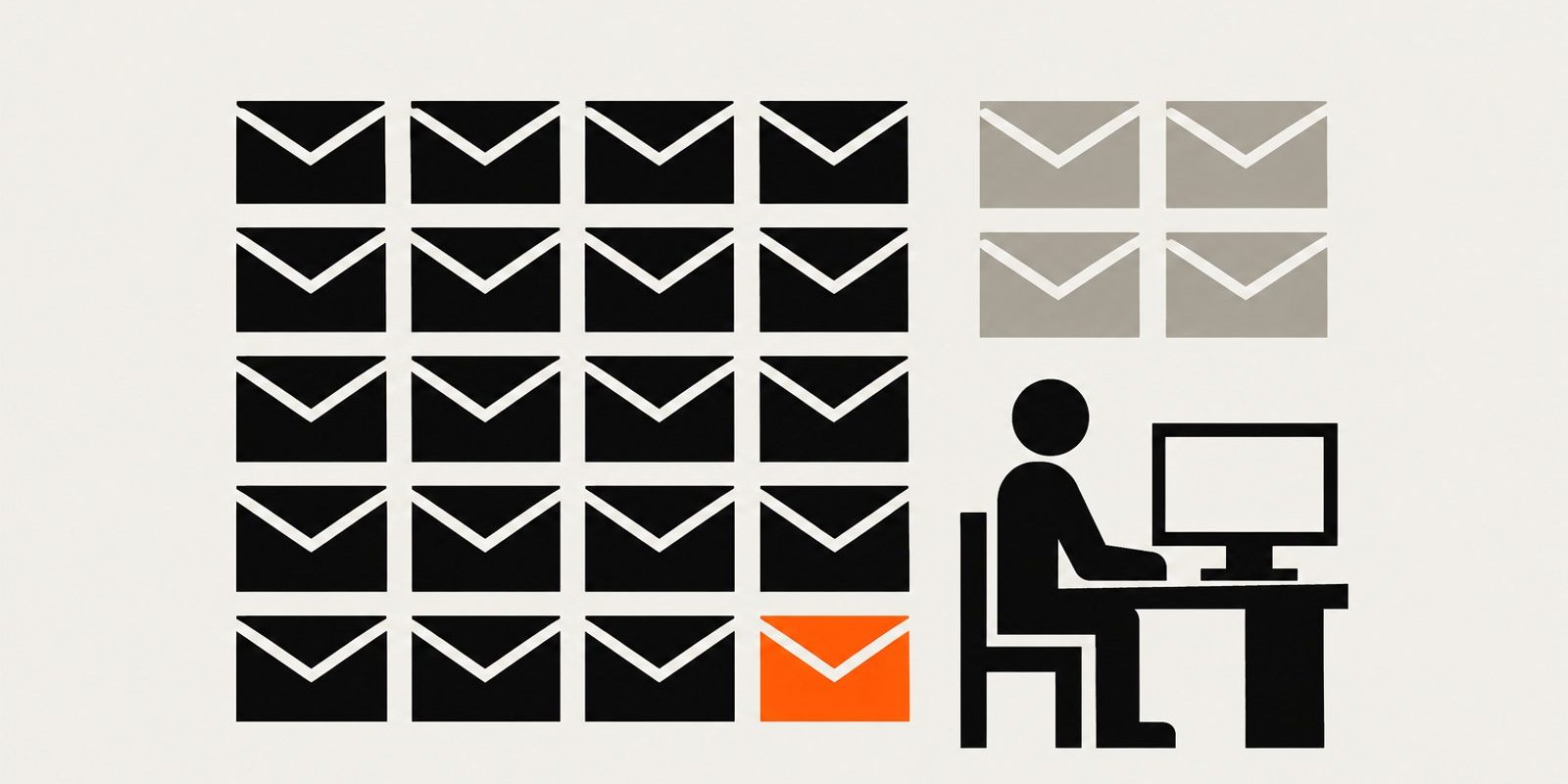
Almost every second email, 44.99% of global traffic, was spam in 2025.
Kaspersky, based on its own telemetry (Kaspersky press release, February 2026)
A year of email
Stretch the 2025 forecast over a full year and it comes to about 137 trillion emails sent and received. That is our own multiplication of 376.4 billion by 365 days. For scale, it is roughly 17,000 messages for every person on Earth, in a single year, most of which no person ever reads.
Why a bigger number is not a better one
It is tempting to read these figures as proof that email is booming. The users figure has risen from about 4.48 billion in 2024 to 4.59 billion in 2025 in the same report, which is about 2.5% growth. Daily volume grew about 4%. Part of that is more people. Part is more automation.
The other complication is that the headline count is dominated by traffic nobody reads. Roughly half is spam, and plenty more is machine-sent. The number of emails that a person sits down and writes to another person is a small fraction of 376 billion, but nobody has measured it reliably.
So when a headline says “376 billion emails every day,” read it as: a forecast, from one research firm, counting sent and received, nearly half of it junk.
Sources
- The Radicati Group, “Email Statistics Report, 2024-2028”, 2024 (figures as quoted in secondary summaries; the report itself was not opened). link
- Kaspersky, “Kaspersky reports 15% growth in malicious email attacks in 2025”, press release, February 11, 2026. link
- Statista, “Number of e-mails sent and received per day worldwide” (citing Radicati). link
- United Nations DESA, “World Population Prospects 2024”, 2024. link