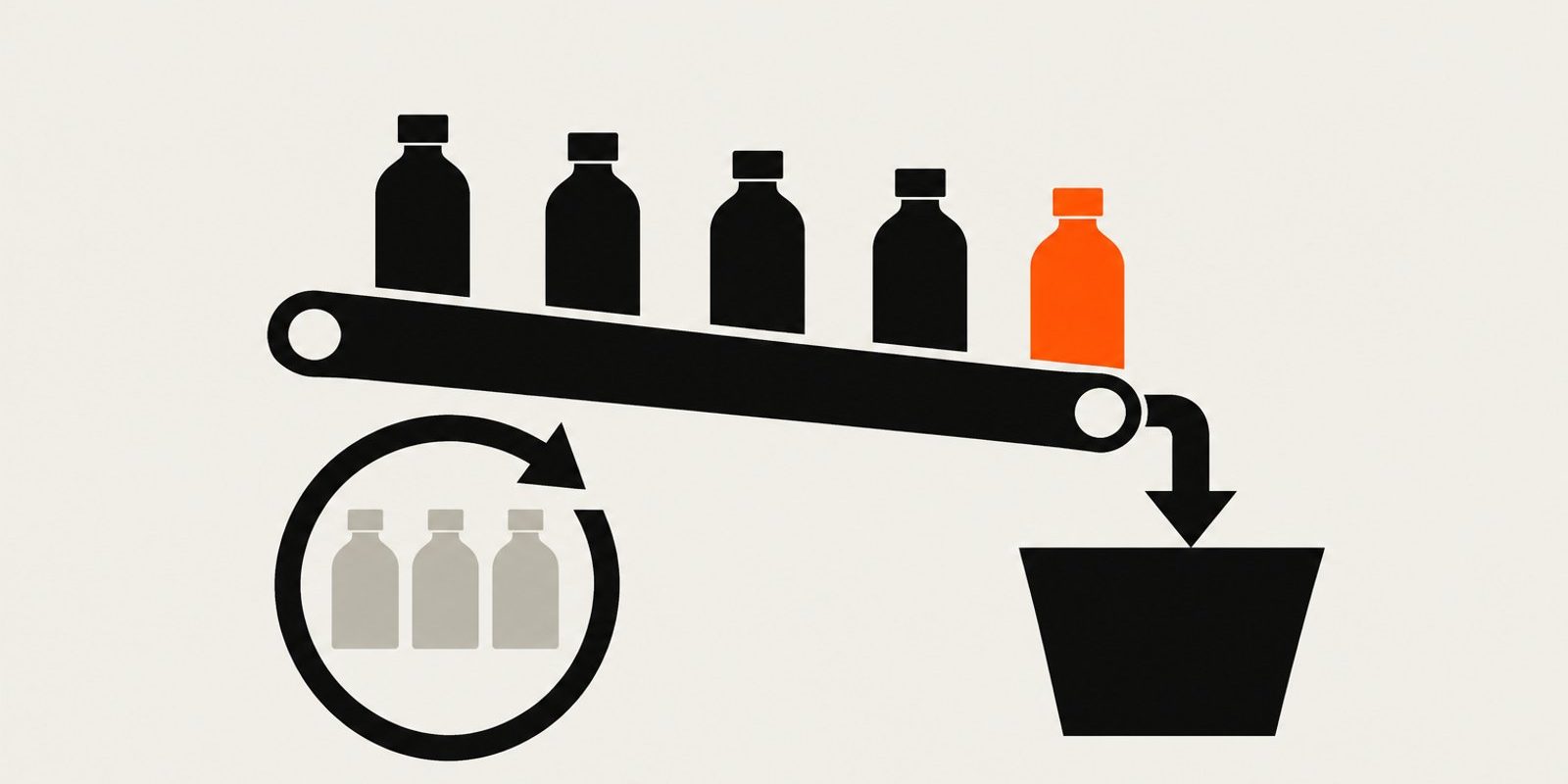
Stand at a checkout line, a vending machine or a gas station cooler for one minute. A handful of plastic bottles will leave the building. Somewhere on Earth, in that same minute, the number is said to be about a million.
That is one of the most repeated environmental statistics of the last decade. It is also an estimate that deserves a closer look, because it is both roughly right and slightly off.
Where “a million a minute” comes from
In June 2017, The Guardian reported that a million plastic bottles were being bought around the world every minute, nearly 20,000 per second. The story drew on data from the market-research firm Euromonitor International, and coverage at the time said people bought more than 480 billion bottles in 2016 and that the number was expected to pass half a trillion by 2021 (Guardian, 2017, as reported by Food Packaging Forum). We could not open the Guardian article itself, so these figures are second-hand, and the exact Euromonitor definitions were not available to us.
Check the arithmetic. A year has 525,600 minutes. A flat million a minute would be about 526 billion bottles a year. The reported 480 billion is closer to 913,000 a minute, or about 15,200 a second. So “a million a minute” is a fair round number for 480 billion. “Nearly 20,000 a second” is a bit high. A million a minute works out to about 16,700 a second.
A number from 2016, not today
The data is nearly a decade old. Statista’s estimate of PET bottles produced was about 485 billion in 2016, with a forecast of 583.3 billion for 2021 (Statista, estimates dated 2017). Those are forecasts, not counts, and “produced” is not the same as “bought.” The two sources agree on scale, but not on exact meaning, so do not treat 480 billion as precise to the digit.
We could not find a verified, newer per-minute figure from the same source. So the honest wording is: “In 2016, an estimated 480 billion plastic bottles were bought, about a million a minute.” Spread over today’s 8.2 billion people (UN DESA, 2024), a year of 480 billion bottles equals about 59 bottles per person. That is a scale comparison, since the 2016 count came from a smaller world population.
What happens to them afterward
The Guardian’s report said fewer than half of the bottles bought in 2016 were collected for recycling, and only about 7% of those collected were turned into new bottles (Guardian, 2017, via secondary reports). Collected is not the same as recycled, and secondary summaries of that article should be read with that caution.
Better-documented figures exist for plastic in general. The OECD’s Global Plastics Outlook found that in 2019 the world generated 353 million metric tons of plastic waste. Of that, only about 9% was ultimately recycled, about 19% was incinerated, almost 50% went to sanitary landfills, and about 22% escaped waste systems into dumps, open burning or the environment (OECD, 2022).
| Measure | Recycling rate | Source, year |
|---|---|---|
| All world plastic waste, ultimately recycled | 9% | OECD, 2019 data |
| All US plastics | 8.7% | EPA, 2018 data |
| US PET bottles and jars | 29.1% | EPA, 2018 data |
| Plastic packaging worldwide, collected for recycling | 14% | Ellen MacArthur Foundation, 2016 |
The twist: bottles recycle better than most plastic
It is easy to read all this as “bottles are the problem.” The data say something more mixed. In the United States, EPA estimated that 29.1% of PET bottles and jars were recycled in 2018, more than three times the 8.7% rate for plastics overall (EPA, 2018). Bottles are among the better-recycled plastics, because they are one material, easy to sort and easy to collect.
Different recycling numbers measure different things. “Collected for recycling,” “recycled” and “turned into new bottles” are not the same, and each loses some material along the way. The OECD, for example, noted that of the 15% of plastic waste collected for recycling, about 40% was disposed of as residues. That is why the OECD ends up at 9% instead of 15%.
A million a minute is a fine headline. It is the fate of the bottles that is the story.
Our own line, not a quote from a source
What to take from it
The big idea is solid. Hundreds of billions of plastic bottles are sold every year, which works out to somewhere around 15,000 to 17,000 per second. The exact figure is an older estimate by a market-research firm, not a government count, and it is only the sales side of the story.
The ending is the part that is better measured. Roughly one in ten pieces of plastic waste worldwide gets recycled, while bottles do somewhat better. The number to remember is the rate, not the million.
Bottles sell by the million a minute, but recycling comes by the tenth.
Sources
- Laville, S. and Taylor, M., “A million bottles a minute: world’s plastic binge ‘as dangerous as climate change'”, The Guardian, June 28, 2017 (citing Euromonitor International; not opened, figures via secondary reports).
- Food Packaging Forum, “Too many plastic bottles”, 2017. link
- Statista, “Production of polyethylene terephthalate bottles worldwide 2004-2021” (estimates, 2017). link
- OECD, “Global Plastics Outlook”, and press release “Plastic pollution is growing relentlessly as waste management and recycling fall short”, 2022. link
- US EPA, “Plastics: Material-Specific Data”, 2018 data. link
- Ellen MacArthur Foundation, World Economic Forum and McKinsey, “The New Plastics Economy: Rethinking the future of plastics”, 2016. link
- United Nations DESA, “World Population Prospects 2024”, 2024. link