Next time you step over an ant on the sidewalk, picture the other ants. Not the ones nearby. All of them, everywhere, at once.
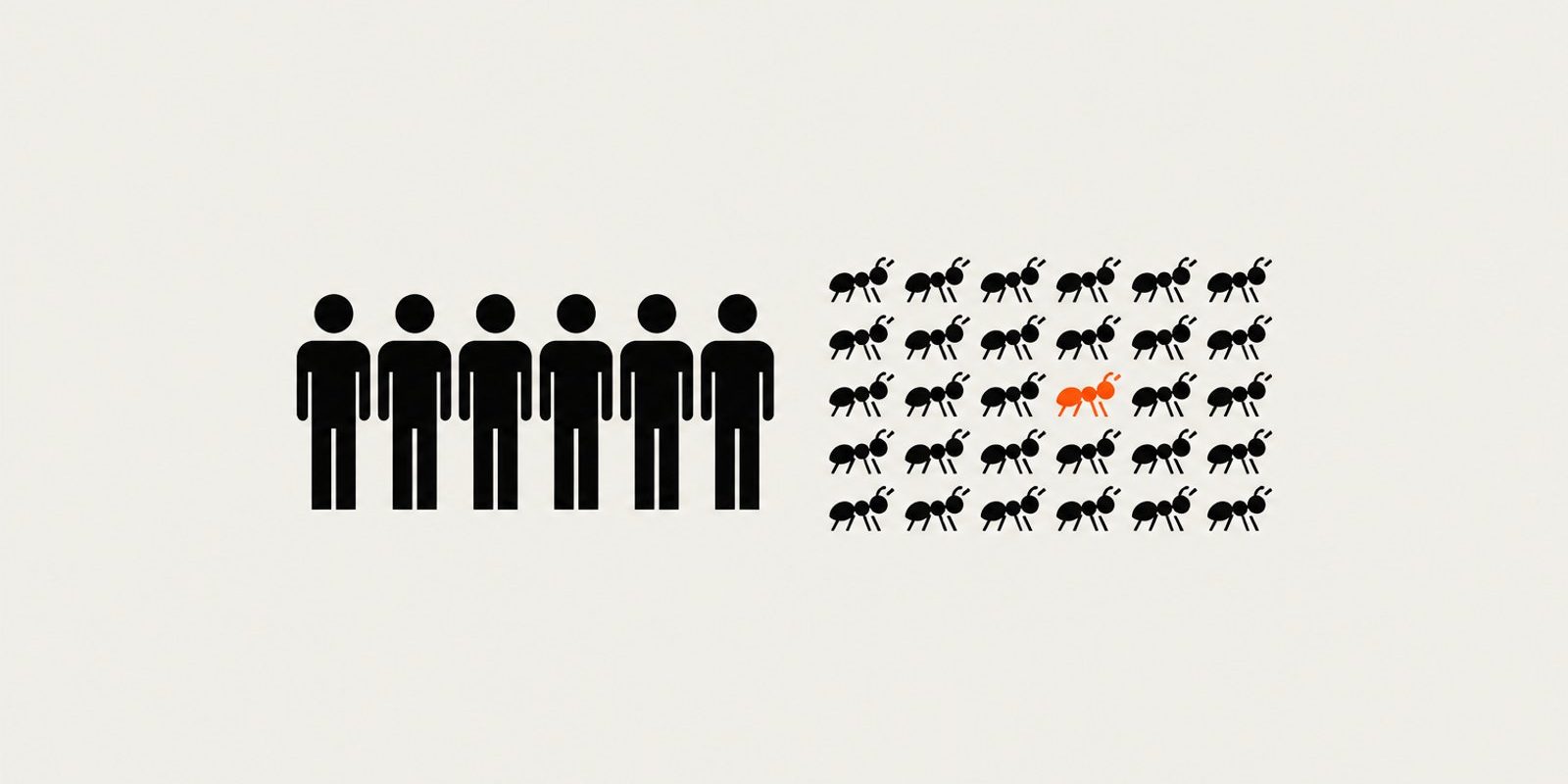
In 2022, a team of scientists tried to count them. Their answer was about 20 quadrillion ants alive right now. That is a 2 followed by 16 zeros. Spread evenly, it works out to roughly 2.4 million ants for every person on Earth.
How do you count a quadrillion anything?
You don’t count them one by one. The team, led by Patrick Schultheiss, gathered data from 489 earlier studies covering every continent and major habitat (Schultheiss et al., PNAS, 2022). Most of the data came from ground-dwelling ants. Researchers had sifted leaf litter or set pitfall traps at 1,306 locations. A smaller set came from fogging treetops with insecticide to count ants living in the canopy.
Then the team did what ecologists do. They worked out the average number of ants per square meter in each type of habitat, and multiplied by how much of the planet that habitat covers. Rainforests and tropical savannas held about 61% of ground-dwelling ants while covering about 38% of the land where ants live (Schultheiss et al., 2022).
What “biomass” really means
Biomass is the total mass of living things. Scientists often measure it in tons of carbon, because carbon is the common building block of all life. It strips out the water, which would make a jellyfish look like a giant.
By that yardstick, ants add up to about 12.3 million metric tons of dry carbon (Schultheiss et al., 2022). The average worker ant weighs only 1.24 milligrams dry, about 0.62 milligrams of that carbon. Multiply that tiny number by 20 quadrillion and you get the total.
Humans come to roughly 60 million tons of carbon (Bar-On, Phillips and Milo, PNAS, 2018). So the ants are about one-fifth of us. The paper says it plainly: ants outweigh all wild birds and wild mammals combined.
| Group | Biomass (million tons of carbon) | Source |
|---|---|---|
| All humans | about 60 | Bar-On et al., 2018 |
| All ants | about 12 | Schultheiss et al., 2022 |
| Wild mammals | about 7.6 (derived) | Schultheiss et al., 2022 |
Why one-fifth is not the whole story
It is tempting to say ants weigh a fifth as much as people and leave it there. But this is a comparison of dry carbon, with the water removed, not of what you would see on a scale. The one-fifth figure is a fair rule of thumb, not a bathroom-scale reading.
The ant number is also soft. The authors give a range of about 9 to 15 million tons for biomass. A later commentary in the same journal called the estimate “almost certainly rather conservative” (Fayle and Klimeš, PNAS, 2022). Ants that live deep underground and in treetops are hard to sample, so the true total is more likely higher than lower.
Ants have been counted the hard way: one leaf-litter sample at a time.
Our own line, not a quote from a source
The tropics hold the crowd
Ants are not spread evenly. They pile up in warm places. A single hectare of Ivory Coast forest was once found to hold about 20 million of them, roughly 2,000 per square meter (Schultheiss et al., 2022). The authors note that such extremes may not be typical. Colder, drier regions have far fewer ants.
That matters because ants do real work. They move soil, spread seeds and eat other insects. A planet with 20 quadrillion of them is a planet that is quietly being turned over by tiny workers.
What the number tells you
Before this study, guesses about the global ant count ranged from 2.5 to 25 million tons of carbon, with little data behind them (Schultheiss et al., 2022). Now there is a data-based answer with honest error bars.
Think of it this way. A single ant is easy to ignore, and so is a single drop of rain. But enough drops make a flood. The study asks us to see the ants the same way, as a layer of life spread over almost every landmass, quietly adding up to something with a fifth of humanity’s carbon mass.
The lesson is about scale. Something as small as an ant can, in sheer numbers, rival the whole human race.
Sources
- Schultheiss, P. et al., “The abundance, biomass, and distribution of ants on Earth”, PNAS, 2022. link
- Fayle, T. M. and Klimeš, P., “Improving estimates of global ant biomass and abundance”, PNAS, 2022. link
- Bar-On, Y. M., Phillips, R. and Milo, R., “The biomass distribution on Earth”, PNAS, 2018. link
- United Nations DESA, “World Population Prospects 2024”, 2024 (about 8.2 billion people in mid-2024). link